It started with a smell people couldn’t place.
Not quite smoke. Not quite dust. Just enough to make heads turn in the middle of an otherwise ordinary Saturday afternoon.
Then someone looked up.
What they saw didn’t make sense at first—bright flashes of orange moving where they shouldn’t be, climbing fast, almost alive.
Within moments, phones were out. Traffic slowed. The air shifted.
This wasn’t a small incident.
It was the kind of scene that makes a busy city hesitate.
The flames weren’t inside, at least not at first. They ran along the outside of the building, racing upward through a lattice that usually blends into the background so well no one notices it.
Until it’s on fire.
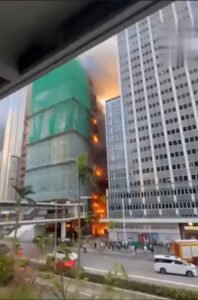
People nearby described a strange mix of awe and fear. The color. The speed. The way debris dropped toward the street below, forcing pedestrians to scatter.
Someone shouted for others to move back.
Someone else froze.
Sirens cut through the confusion, sharp and insistent, growing louder by the second. Emergency vehicles poured in from multiple directions, red and blue lights bouncing off glass towers.
Office workers were ushered out quickly. Shops closed without explanation. A routine weekend afternoon in one of the world’s busiest business districts suddenly felt fragile.
Like it could tip either way.
From the street, the fire looked worse than it was—at least at first. Thick smoke rose into the sky, dark enough to be seen blocks away.
Online, videos began circulating almost immediately.
People watching from afar wondered the same thing: How bad is this really?
Firefighters moved fast, but the blaze didn’t give up easily. The material feeding it burned hot and stubborn, forcing crews to stay at it far longer than many expected.
Hours passed.
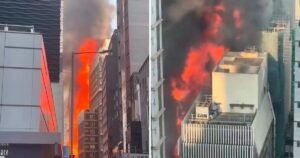
As daylight faded, the glow of flames against the building’s exterior became even more unsettling. The kind of image that sticks with you long after you scroll past it.
Inside nearby hospitals, staff quietly prepared.
Outside, crowds waited for updates that didn’t come right away.
It wasn’t until much later that officials confirmed the fire had finally been brought under control—nearly five hours after it began.
By then, exhaustion showed on every face at the scene.
And the questions were just beginning.
People wanted to know what caused it. Whether the building itself was compromised. Whether anyone had been seriously hurt.
Early reports were cautious. Almost restrained.
What was known, though, was this: four people had been taken to the hospital.
Their injuries varied. Burns. Smoke inhalation. Trauma from falling debris.
At least two of them were in serious condition initially.
That detail hit harder than the footage.
A 23-year-old man. A 55-year-old man. A woman in her 30s. A man in his 60s.
Ages that made it feel closer to home.
As night settled in, officials began inspecting the structure itself. That was the part many people were waiting for.
Because a fire that dramatic on the outside raises a terrifying question—what about what you can’t see?
Around the 60–70% mark of the unfolding story, the key update finally arrived.
The building had been declared structurally safe.
No major damage. No signs of compromise to its core.
For many watching, that announcement landed with a mix of relief and disbelief.
How could something that looked so violent leave the structure standing?
Authorities explained that the fire had stayed largely confined to the exterior scaffolding. The interior spaces, while evacuated, were not seriously affected.
It was a narrow escape.
One that could have gone very differently.
Investigators were assigned almost immediately. Their job: figure out how the fire started, why it spread so quickly, and whether anything—or anyone—was at fault.
Those answers won’t come quickly.
In the meantime, attention turned back to the injured.
By the following day, updates trickled out. The man who had initially been listed in critical condition was now considered serious but stable. Another, once critical, had improved.
The remaining two were also stable.
Small mercies, people said.
Still, “stable” doesn’t erase what happened.
The shock. The fear. The sudden realization that a normal day can fracture without warning.
For those who were there, the memory will linger—the sound of crackling fire above their heads, the instinct to run, the uneasy quiet after the flames were finally extinguished.
And for everyone else, there’s the image.
A familiar skyline disrupted.
A reminder that even in places built on steel and glass, unpredictability finds a way in.
Officials continue to monitor the situation. Engineers review reports. Investigators replay timelines.
The street has reopened. Life has resumed its rhythm.
But not without a subtle shift.
Because once you’ve seen fire climb where it shouldn’t, once you’ve watched smoke swallow a piece of a city you thought you understood, it changes how you look up.
And somewhere between relief and unanswered questions, this story is still breathing—waiting for the next detail to surface.