At first, people thought it was part of the routine.
The music was still playing. The lights hadn’t changed. The water shimmered the way it always does during moments meant to amaze.
Then someone screamed.
It cut through the air in a way that didn’t belong to a show. Sharp. Panicked. The kind of sound that makes your stomach drop before your brain catches up.
A few spectators laughed nervously at first. That split second where your mind tries to protect you by assuming everything is fine.
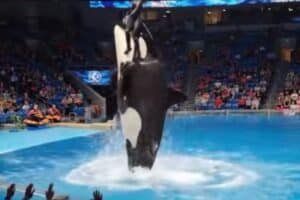
It wasn’t.
What was supposed to be a familiar interaction suddenly felt wrong. Too fast. Too forceful. Too quiet in all the wrong places.
People leaned forward in their seats, confusion spreading. Some stood. Others froze, unsure whether they were watching something rehearsed or something they were never meant to see.
Then the water moved differently.
There’s a moment witnesses keep describing — when the realization hit all at once. When the crowd understood this wasn’t choreography. This was fear.
And it was real.
Staff rushed toward the edge of the pool. The music stopped. Shouting replaced it. The kind of shouting that carries urgency, not excitement.
Phones came out, then dropped back down. Not because people were told to stop recording — but because it suddenly felt wrong to look through a screen.
Something had gone terribly off script.
The animal, massive and powerful, moved with a force that made even seasoned onlookers gasp. In one horrifying instant, the trainer was gone from sight, pulled beneath the surface.
The water closed over her.
Seconds stretched. Long enough for hope to flicker. Long enough for disbelief to linger.
Then panic took over completely.
Emergency crews were called. Protocols kicked in. Everything that could be done was done — fast, frantic, desperate.
But sometimes speed isn’t enough.
People were escorted out quietly. Some cried openly. Others sat in stunned silence, replaying what they had just seen over and over, trying to make sense of it.
How does something so practiced turn so violent?
How does trust break that suddenly?
Behind the scenes, coworkers stood shaken. These weren’t just colleagues. This was family. The kind built through early mornings, long hours, and shared respect for animals most people never get close to.
She wasn’t reckless. Everyone agrees on that.
She was careful. Methodical. Deeply connected to the animals she worked with.
That’s what made it so hard to understand.
She had spent years building a relationship with the orca involved. Years learning its patterns, moods, subtle signals that outsiders would never notice.
This wasn’t a new pairing.
This wasn’t inexperience.
This was someone who believed — truly believed — in the bond between human and animal.
Friends say she spoke about her work with quiet pride, not ego. She didn’t see herself as dominant. She saw herself as a partner.
That belief shaped everything she did.
Which is why the question keeps hanging in the air, unanswered.
What changed?
Investigators are now trying to piece together those final moments. Looking for a trigger. A sound. A movement. Anything that could explain the sudden shift in behavior.
Because orcas are not machines. They’re intelligent. Emotional. Unpredictable in ways science still can’t fully explain.
And that unpredictability is part of what makes them so mesmerizing — and so dangerous.
Only later did the full weight of the loss settle publicly.
Her name was Jessica Radcliffe.
A trainer known in marine circles not for fame, but for heart. For patience. For treating animals not as attractions, but as living beings with agency and power.
To those who knew her, she wasn’t fearless because she ignored danger.
She was fearless because she respected it.
That’s the part that hurts the most.
The facility now faces growing scrutiny. Questions that have lingered for years are resurfacing, louder this time. About captivity. About performance. About whether these animals were ever meant to live this way.
There are no easy answers.
Some say this was a tragic anomaly. Others say it was inevitable.
What everyone agrees on is that a life was lost — suddenly, violently, and in front of people who will never forget the sight.
For her family, the loss is quieter but deeper. No crowd. No noise. Just absence where laughter used to be. Just memories that now ache instead of comfort.
For her coworkers, the pool will never look the same.
And for the audience members who were there that day, something shifted. The magic cracked. The illusion dissolved.
Because once you see how thin the line is between wonder and danger, you can’t unsee it.
Jessica’s story doesn’t end cleanly. There’s no lesson neatly wrapped up. No moral that makes it make sense.
Just a lingering question.
And the uneasy feeling that this conversation — about risk, about control, about nature — is far from over.