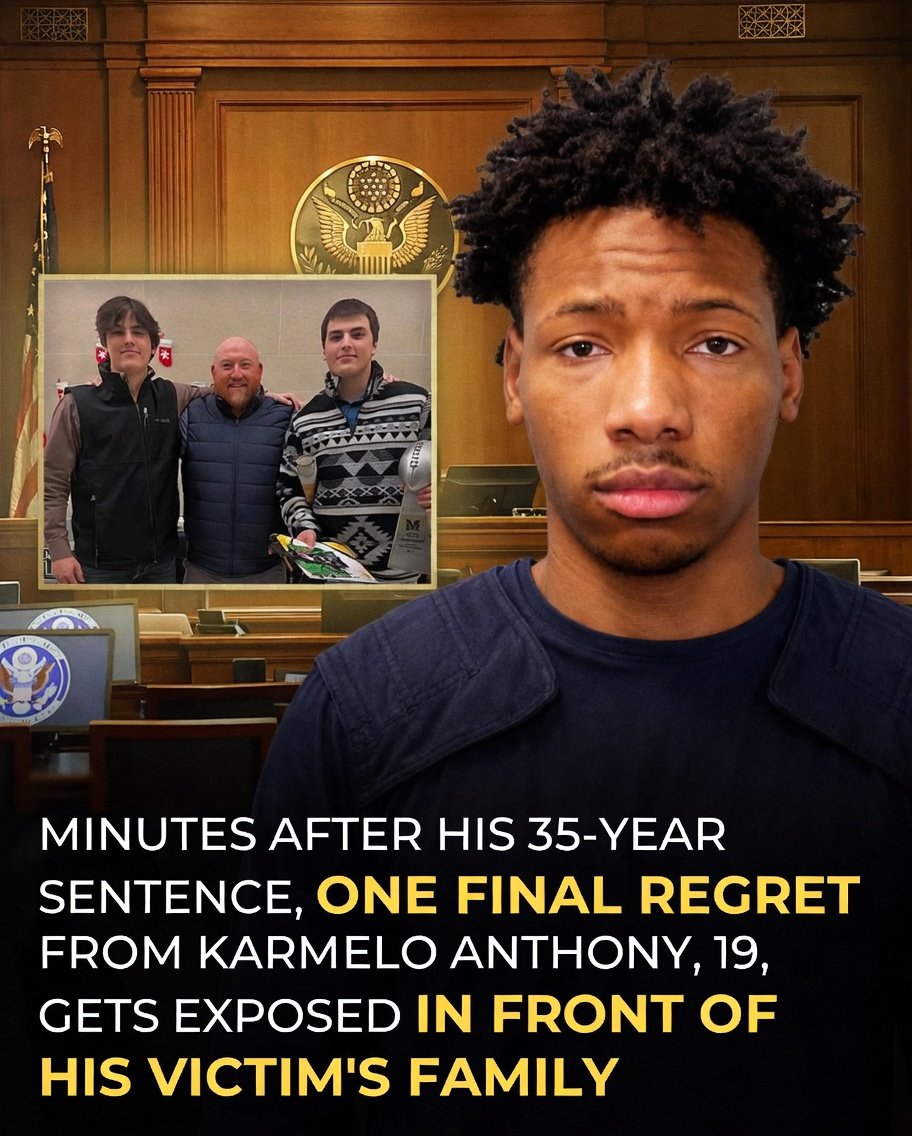
A Texas jury handed down a major ruling in the case against Karmelo Anthony for the killing of Austin Metcalf. The decision came after jurors threw out a self-defense claim and refused to find that the death occurred under what Texas law defines as ‘sudden passion.’
Was Karmelo Anthony defending himself, or did prosecutors succeed in proving his use of force was not legally justified? That question sat at the heart of a trial at the Collin County Courthouse, where jurors ultimately found him guilty of murder, rejected a push for a lighter sentence, and sentenced him to 35 years behind bars.
Jurors spent fewer than three hours going over the evidence after hearing sharply conflicting accounts of the confrontation that unfolded during a high school track meet on April 2, 2025.
According to NBC DFW, Karmelo admitted to fatally stabbing Frisco student Austin Metcalf during the incident. Both Karmelo and Austin were 17 years old at the time. Karmelo is now 19.
Before deliberations began, prosecutors and defense attorneys used the trial’s final hours to lay out competing explanations for what happened and whether Karmelo’s actions were legally defensible.
The last day of the trial got underway shortly after 9:15 a.m. on Tuesday, June 9, 2026, with a dispute over what the jury would be permitted to weigh.
Judge John Roach addressed proposed jury instructions, including a legal concept known as ‘provoking the difficulty.’ That doctrine can undercut a self-defense claim if jurors determine the defendant deliberately provoked the encounter.
Defense attorney Mike Howard objected to including that instruction, but Judge Roach denied the request and kept it in the jury charge.
The judge also declined to add criminally negligent homicide as a potential verdict. He did, however, allow manslaughter to stand as a lesser included offense.
Just before 9:30 a.m., Judge Roach explained that jurors would have three possible outcomes to choose from: murder, manslaughter, or not guilty.
Karmelo had entered a not guilty plea to the murder charge, and the judge reminded jurors that he was presumed innocent unless prosecutors proved the case beyond a reasonable doubt.
Judge Roach also instructed jurors to weigh Karmelo’s self-defense claim and consider whether he had given that up by provoking the confrontation.
The gap between the potential verdicts was significant. A murder conviction carried a sentencing range of five to 99 years, while manslaughter carried a possible sentence of two to 20 years.
At 9:56 a.m., Howard opened his closing argument by urging jurors to focus on what Karmelo believed in the moments leading up to the stabbing.
Howard argued that Austin had the right to ask Karmelo to leave the Memorial High School tent, but did not have the legal right to use physical force against him.
‘The government wants this case to be about, Melo could have just left,’ Howard told jurors. ‘Sure, he could have. I’m sure he wishes he did.’
From there, Howard painted the confrontation as a rapidly unfolding situation in which Karmelo felt cornered. He pointed to testimony that Karmelo stayed seated while Austin and others stood over him inside the tent.
Howard also highlighted testimony that Karmelo repeatedly warned those around him not to touch him.
‘If I look at you and repeatedly tell you, Don’t touch me, I have something in my bag, that is the ultimate warning to back off,’ Howard argued.
Howard contended that Karmelo genuinely believed he was protecting himself. ‘There is no evidence Karmelo did anything but really think he was defending himself in that split second of chaos,’ Howard told jurors.
He also pointed to Karmelo’s behavior after the stabbing, including testimony that he became emotional and asked whether Austin would survive.
At 10:18 a.m., prosecutor Bill Wirskye delivered the state’s rebuttal and urged jurors to reject the defense’s version of events. ‘Do not let them turn a threat into a warning,’ Wirskye told jurors.
Wirskye argued that Karmelo brought a concealed knife to the track meet and used deadly force in a situation that did not call for it.
‘He took a knife to a track meet,’ Wirskye said. ‘He had a secret, he kept it hidden… He was the only one with a knife that day. He was always going to come out on top that day.’
According to FOX 4 News, Wirskye called the incident a ‘provoked, unjustified murder.’ He argued that Karmelo walked into a closed team tent and carried out what he called a ‘sneak attack’ before running away.
Wirskye also questioned why Karmelo didn’t simply walk out of the tent before things escalated. ‘You don’t get to meet a shove with a stab, especially if you provoke the shove,’ he argued.
The prosecutor told jurors the case had nothing to do with race and did not involve lawful self-defense. He argued the evidence backed the state’s account and wrapped up by saying, ‘Ultimately, this case is about accountability.’
At 10:50 a.m., jurors left the courtroom to begin deliberating. They had to decide whether prosecutors had proved murder, whether manslaughter applied instead, or whether Karmelo should walk free.
By early afternoon, people started filing back into the courtroom as everyone prepared for the jury’s return.
At around 2:14 p.m., Karmelo and his legal team re-entered the courtroom.
According to NBC DFW, Karmelo’s mother appeared to have been crying while waiting in a nearby room. Karmelo sat alongside his attorneys as the court prepared to receive the verdict.
Shortly after, Austin’s twin brother, Hunter Metcalf, walked in and sat down with his parents, Jeff and Meagan Metcalf.
Just before 2:30 p.m., the jury came back with its answer. After fewer than three hours of deliberations, jurors found Karmelo guilty of murder.
Karmelo reportedly showed almost no visible reaction as the verdict was read aloud. His mother wept in the gallery, and supporters around her also appeared shaken.
Across the courtroom, Hunter leaned forward in his seat as the decision was announced. The proceedings then moved straight into sentencing.
Both sides waived opening statements in the sentencing phase, and the state immediately rested. The defense then called Karmelo’s mother, Kala Hayes, to the stand. Kala grew emotional while speaking about her son.
‘He’s my oldest,’ she told jurors. ‘He’ll always be my baby. I love him very much.’ When Howard asked whether Karmelo felt remorse, Kala answered without hesitation.
‘Yes, I know my son, and he’s very sorry for what he did,’ she testified. Howard then asked whether she had anything more to say to the jury. ‘Please have mercy on my son,’ Kala said.
Although Karmelo had been convicted, the length of his sentence still hinged on one more legal question.
The defense argued that the offense was carried out under what Texas law calls ‘sudden passion.’ If jurors agreed, the punishment range would fall from five to 99 years down to two to 20 years.
Prosecutors argued the standard didn’t apply. During sentencing arguments, Wirskye told jurors that sudden passion must stem directly from provocation by the person who was killed.
The state maintained that Karmelo, not Austin, had provoked the confrontation. At 4:40 p.m., jurors left the courtroom once more to deliberate on Karmelo’s sentence.
Before the day’s proceedings wrapped up, Austin’s twin brother delivered one of the most emotional victim impact statements of the entire trial.
Hunter asked Karmelo to look up and meet his eyes. Karmelo, who had been staring downward during the statements, lifted his gaze.
‘You took a son, a brother, a friend, and my best friend, from this world,’ Hunter told him. ‘You took someone from me who was supposed to be an uncle, godfather to my kids. Now I want everything taken from you.’
Hunter said he had spent the past year trying to learn forgiveness and make sense of why his brother had to die. He also said he wakes up every morning knowing he can never talk to Austin again.
Hunter told Karmelo that his mother still cries herself to sleep. When he finished his statement, he stepped down from the stand and embraced those around him.
At 7:30 p.m., jurors returned to the courtroom for the final ruling of the day.
Judge Roach announced that the jury had rejected Karmelo’s sudden-passion claim. Jurors found that Austin’s death did not happen under the immediate influence of sudden passion arising from adequate cause.
They then sentenced Karmelo to 35 years in state prison. Under Texas law, he must serve at least half of that sentence before he can be considered for parole.
Moments before the sentence was read, Karmelo appeared to be sobbing as members of his defense team tried to comfort him.
According to courtroom sketch artist Pat Lopez, Karmelo later glanced toward his parents and mouthed the words ‘I’m sorry’ before being led out of the courtroom. Judge Roach then ordered that he be taken into custody.
With the courtroom proceedings concluded, attention turns back to the confrontation at a Frisco track meet that prosecutors and defense attorneys spent months picking apart before a jury.
On Wednesday, April 2, 2025, the bleachers at Kuykendall Stadium in Frisco, Texas, were packed with students competing in the 11-5A district track meet. The event brought together more than a hundred student-athletes from eight Frisco Independent School District high schools, including Memorial High School and Centennial High School.
Under the tent set aside for Memorial High athletes, a confrontation broke out between Austin, a junior at Memorial, and Karmelo, a student from Centennial. Witnesses told police that Karmelo, who was wearing a Centennial tracksuit, sat in the wrong tent, and Austin told him to leave.
According to the police report, Karmelo opened his bag and said, ‘Touch me and see what happens.’ Statements from multiple students indicated that Austin either touched or tried to move Karmelo. In the next moment, Karmelo allegedly pulled a knife from his bag and stabbed Austin once in the chest.
Witnesses said he then fled from the tent area. A black knife with blood on it was later recovered by officers in the bleachers. Coaches and certified athletic trainers rushed over immediately, performing CPR and applying pressure while waiting for emergency services to arrive.
Austin was taken to a nearby hospital, where he was pronounced dead at 10:53 a.m. According to the official arrest report, the entire altercation, from the verbal exchange to the stabbing, lasted under 30 seconds.
Police noted that more than 30 students and half a dozen coaches from five schools were listed as witnesses, many of whom gave statements on-site.
Minutes after the stabbing, a Frisco school resource officer found Karmelo near the stadium. He matched descriptions given by several student witnesses. According to the police report, officers spotted blood on his left middle finger and ordered him to raise his hands. He did.
Before officers could ask any questions, Karmelo began making unsolicited statements. ‘I was protecting myself,’ he said. When one officer radioed that he had the alleged suspect, Karmelo reportedly shot back, ‘I’m not alleged, I did it.’
As he was walked to a patrol car, he added, ‘He put his hands on me. I told him not to.’ Witnesses at the scene described him as ‘crying hysterically.’ Officers said he appeared visibly shaken during the arrest. Once seated in the back of the squad car, Karmelo asked if the victim was ‘going to be OK.’
He then asked officers whether the stabbing could be considered ‘self-defense.’ Another officer noted that Karmelo seemed emotional throughout and repeated several of those statements without being prompted. He was taken to the Frisco City Jail and later moved to the Collin County Jail.
Austin’s mother, Meagan, was at work in Grapevine when she got a call from Hunter. ‘He was screaming that Austin had been stabbed,’ she said in a televised interview. She drove straight to the hospital and arrived before the ambulance.
‘I saw them have him come out,’ she recalled. ‘He was on a lot of machines, and it didn’t take long for them to come in to say that he had passed.’ Her husband, Jeff, said Hunter had witnessed the stabbing and tried desperately to save his brother’s life.
‘He was holding his hands on the hole trying to save his life,’ Jeff told CBS News Texas. ‘He told me, I looked at him, his eyes — he was gone, he wasn’t breathing.’ According to Meagan, CPR was performed after Austin was unresponsive for about five minutes.
‘They were able to revive him a little, but I think it was just, too little too late,’ she said. In a separate interview, Hunter also described what he witnessed.
‘I whipped my head around, and then all of a sudden I see him running down the bleachers just grabbing his chest. I put my hand on there, tried to make the bleeding stop, and I grabbed his head and I looked in his eyes. I just saw his soul leave, and it took my soul, too,’ he stated.
The family put out a written statement two days later, through a friend, thanking the community for their prayers and support. ‘We will entrust the detectives handling the investigation to determine the circumstances surrounding Austin’s passing,’ the statement read.
‘While our family, Hunter, and I prioritize commemorating and honoring Austin, we extend our gratitude to everyone who has supported us in numerous ways and helped sustain our family during this difficult time,’ it concluded.
More than a year after the deadly confrontation at a Frisco track meet, jurors answered the questions that sat at the core of the case. Their verdict and sentencing decision brought the trial of Karmelo Anthony to a close.