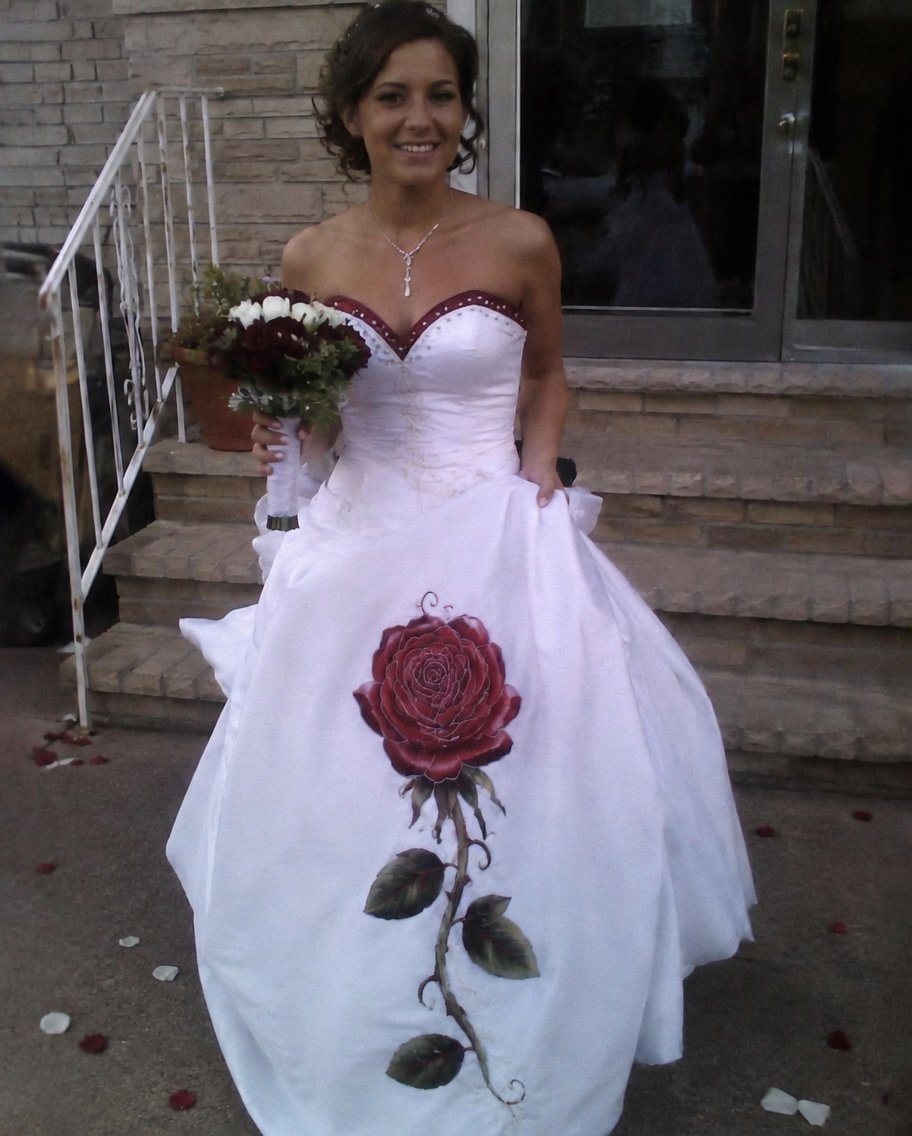
My wedding dress wasn’t just a piece of clothing. My grandmother had stitched parts of it with her own hands, my mother had walked down the aisle in it before me, and I had stored it carefully for the daughter I hoped would one day wear it herself. My mother-in-law knew every bit of that history, yet she did something that shattered my world completely.
My grandmother was not someone who showed love through words.
> She showed it through her hands.
She stitched quilts for every grandchild at birth, embroidered pillowcases for birthdays, and mended things other people would have discarded because she believed that anything worth keeping deserved the effort of being kept properly.
When my mother got engaged in 1974, my grandmother spent four months hand-sewing parts of her wedding gown — including the lace overlay on the bodice, the delicate trim along the hem, and the tiny fabric-covered buttons running all the way down the back.
She didn’t construct the entire dress.
> But the sections she worked on stood out the most.
My mother wore it on a Saturday in October and always called that day the finest of her life, second only to the day I was born — a claim she made with a smile that made it clear she considered it a very close race.
After the wedding, the dress was preserved with the same seriousness my grandmother brought to everything worth saving. It was cleaned, wrapped in acid-free tissue, and placed in a proper archival box.
> It moved with my parents through three different homes over thirty years.
It arrived in the closet of my childhood bedroom around the time I turned ten, and I would occasionally lift the lid and stare at it with the quiet reverence children reserve for things they sense are important without fully grasping why.
When Marcus proposed to me at 29, there was never really any question about which dress I would wear.
After minor alterations, it fit as though it had been sewn for me rather than my mother — something my grandmother said at the fitting was no coincidence, because I had always been my mother’s daughter through and through.
> It was beautiful.
I wore it on a June afternoon while my mother wept in the front pew and my grandmother, then 81, sat perfectly upright and did not cry at all because she considered public crying untidy. Even so, I caught her pressing her handkerchief to the corner of her eye twice during the ceremony.
After the wedding, I stored it exactly the way my mother had before me. I had it cleaned, wrapped it carefully, and placed it in a box in our storage room.
> I had even attached a little handwritten label to it.
I had intentionally placed it on the second shelf from the top, alongside other things that mattered deeply — my mother’s letters, my grandmother’s recipe book, and a collection of photographs I had sorted by decade.
My daughter Sophie was six at the time of the wedding and already enchanted by the dress the way small girls are enchanted by things that feel like magic.
She would ask me to retell its story — the grandmother’s hands, the buttons, the October wedding — with the hunger of a child who wants her favorite story delivered exactly the same way every single time.
I always told it the same way.
> Because it deserved to be told that way.
My mother-in-law, Evelyn, knew all of this.
I had shared the history of that dress with her more than once, including a time when she had asked about the labeled boxes sitting in our storage room.
‘What’s in this one?’ she asked, pointing at the large preservation box on the shelf.
‘My wedding dress,’ I said.
‘You kept it?’
> I laughed. ‘Of course I kept it.’
I opened the box gently and showed her the ivory lace and the row of tiny hand-covered buttons.
‘My grandmother sewed those herself,’ I told her. ‘My mother wore this dress in 1974, and then I wore it. It’s probably the most meaningful thing I own.’
Evelyn leaned in for a closer look.
‘It really is lovely,’ she admitted.
> ‘I’m hoping Sophie might wear it one day.’
Evelyn glanced toward the living room, where Sophie was coloring at the kitchen table.
‘You really think she’ll want her mother’s old wedding gown?’
‘Maybe. Maybe not. But I want her to have the choice.’
Evelyn nodded slowly.
‘Well, that’s a sweet thought,’ she said. ‘It certainly sounds like something special.’
> Then she smiled.
In seven years of knowing Evelyn, I had come to understand that her smiles carried different meanings. Some meant genuine warmth. Some meant quiet amusement. And some meant she had already made up her mind about something and had no intention of saying so.
In that moment, I couldn’t tell which one it was.
Evelyn was a woman who moved through life with the unshakeable certainty of someone who had never seriously considered that her own judgment might be mistaken.
She was organized, efficient, and helpful in practical ways I genuinely appreciated. She could fix, arrange, and sort through things with a speed and decisiveness I sometimes envied.
> The problem was that she rarely stopped to ask whether a decision was actually hers to make.
Over the years, there had been smaller incidents.
A set of curtains she had swapped out while we were away for a long weekend because she found the originals outdated. A box of books she had donated to a charity shop after deciding they were cluttering the hallway — including two that had belonged to Marcus’s grandfather.
Each time, she had been genuinely taken aback by any upset, because in her mind she had simply been helpful, and helpfulness was justification enough.
> Marcus and I had talked about it.
He agreed with me in theory and struggled in practice — a dynamic I suspect many people married to someone with a forceful parent will recognize immediately.
He loved his mother. He found direct confrontation with her genuinely painful. We had developed a way of managing things that mostly worked, which involved me being far more explicit than I should have had to be about what was and was not to be touched when she was in our home.
> I believed I had covered everything that mattered.
We left for a two-week vacation in Portugal in September, and Evelyn offered to house-sit — water the plants, collect the mail, keep an eye on things.
She had done it before without any problems, and we were grateful. I believed, genuinely, that we had established a clear enough understanding of boundaries that we could leave without a second thought.
> I had no idea just how wrong I was.
We arrived home on a Sunday evening, tired but happy after finally taking that trip.
I had no reason to go into the storage room for several days. Life fell back into its usual rhythm. The laundry was done, the groceries were bought, Sophie returned to school, and Marcus went back to work.
The following Saturday, I drove to Evelyn’s house to help her clear out a section of her garage she had been meaning to tackle for months.
We spent the morning shifting boxes and making decisions about what to keep and what to throw away. Evelyn was in fine spirits.
> She was brisk, chatty, and cheerful — as she often was.
We were about two hours in when she said it.
‘Oh, by the way,’ she said, carrying a box toward the door without glancing up. ‘I finally cleared out that old dress that was taking up space in your storage room.’
I stopped moving entirely.
I actually laughed first. A short, bewildered sound. Because the alternative — that she was serious — was so far beyond anything I was ready to process that laughter was the only response my brain could immediately produce.
> ‘What dress?’ I said.
She set the box down and looked at me with mild surprise at my tone. ‘Your wedding dress. The one in the box in the storage room. It was just sitting there, Claire. Someone else can enjoy it now.’
The world did something strange around me. Not exactly spinning. More like a sudden, complete stillness, as though everything had paused to let that information fully settle.
> ‘You sold my wedding dress?’ I asked.
‘I listed it online while I was house-sitting. It sold very quickly, actually. Someone paid a good price for it.’ She said this with a faint note of satisfaction, as though the speed of the sale was somehow a point in her favor.
‘Evelyn.’ My voice was very steady in the way voices sometimes become when the alternative is something far louder. ‘That dress belonged to my mother. My grandmother sewed parts of it by hand. Sophie has been hearing the story of that dress her whole life.’
> I could feel my hands shaking with anger.
She looked at me with the expression she used whenever she felt a reaction was out of proportion.
‘It was just sitting in a box,’ she said. ‘It’s not as if you were wearing it. Someone else can enjoy it now.’
I drove home and went straight to the storage room. I stood in front of the shelf where the box had been, staring at the empty space it had left behind, for a long time.
> I spent three weeks trying to get it back.
I tracked down the listing through the platform’s sold history after a great deal of searching.
The buyer was a woman in another state who had purchased it for her own upcoming wedding. When I reached out and explained everything, she was genuinely sympathetic — and genuinely unwilling to part with it.
> She told me she had fallen in love with the dress.
It was already being altered. She was sorry, she said, and she sounded as though she truly meant it — but there was nothing she could do for me.
The dress was gone, and it was not coming back.
Sophie cried when I told her, with the raw, uncomplicated grief of a twelve-year-old who has not yet learned to hold her sadness quietly. I held her and felt something harden inside me — something I recognized as purposeful rather than simply angry.
> Throughout all of this, Evelyn remained entirely consistent in her position.
She felt the dress had been sitting unused, and someone else was getting enjoyment from it now. She thought I was simply being emotional.
Whenever I raised it directly, she would nod with the patient expression of someone tolerating an unreasonable person, and when I eventually stopped raising it, she apparently read the silence as acceptance.
At a family dinner six weeks after our return, with Marcus’s extended family gathered around a long table, Evelyn brought it up herself.
She was telling a story about house-sitting and how productive she had been during our absence, and the wedding dress came up as an example of her efficiency.
‘Claire’s still upset about that dress,’ she said.
> ‘I keep telling her it was only a piece of fabric.’
Several people laughed the way people laugh when they aren’t sure what the joke is but feel the social pull to respond. And I smiled.
Because I had been watching Evelyn at family gatherings for seven years, and I knew something the rest of the table was about to understand very clearly in the not-too-distant future.
> You see, Evelyn had a jewelry box.
It had belonged to her grandmother. It was a small, hand-painted wooden box with a brass clasp that she kept on her bedroom dresser and mentioned with the frequency and reverence of someone who regards an object as genuinely sacred.
She brought it up at gatherings. She had shown it to Sophie. She had told the story of how her grandmother had painted the flowers on the lid herself, how it had survived a house fire, and how she intended to pass it on to Marcus’s future daughter one day.
> She spoke about it exactly the way I had always spoken about the dress.
The irony of this had not been lost on me.
What had escaped her, apparently, was that the rest of the family had also been listening to that story for years.
Our family reunion was scheduled for the following month. It was an annual event held at Marcus’s aunt’s property, where three generations came together for a full weekend.
> I had been asked to put together a small presentation celebrating the family’s history.
I agreed, since it was something I had done before and genuinely loved doing.
I started quietly, reaching out to family members one by one and asking for photographs and stories — old weddings, inherited objects, cherished recipes, and things passed down through the generations.
Everyone was enthusiastic. Everyone had something to offer.
> I also included the story of the wedding dress.
I told it fully and without any editorial comment — the grandmother who sewed the buttons, the mother who wore it in October 1974, the daughter who wore it in June, and the granddaughter who had grown up hearing the story and hoped one day to continue it.
I included photographs from every stage. The final image was the empty shelf in the storage room.
> I did not name Evelyn anywhere in the presentation. I did not need to.
The reunion arrived on a warm Saturday.
Families spread across the lawn with folding chairs and plates of food, and in the early afternoon, everyone gathered in the barn for the presentation.
I had assembled it with care, and it was genuinely moving — old photographs, the voices of relatives sharing memories, and the layered evidence of everything a family carries with it through time.
> Then came the wedding dress segment.
The room fell quiet as they watched.
Sophie, sitting beside me, told the story herself in her own words — something she had asked to do and which I had agreed to without hesitation.
She talked about the buttons her great-great-grandmother had sewn by hand. She talked about the story her mother had told her since she was small. She talked about the hope she had carried for years that the dress would one day belong to her.
Then she said, simply and without drama, that the dress was gone now.
> She said it had been sold by someone who had decided it didn’t matter.
The room stayed quiet.
Then someone asked, gently, what had happened. Marcus explained. He had not been fully willing to do that in smaller settings, but in this room, facing four generations of his family with his daughter’s composed twelve-year-old voice still hanging in the air, he told the truth.
> No one went after Evelyn. No voices were raised.
But the faces of people who had spent years listening to her tell the story of her grandmother’s jewelry box said everything that needed to be said without a single word being spoken.
One of Marcus’s aunts, a woman in her seventies who had known Evelyn for decades, looked at her and said quietly, ‘Would you want someone to decide your grandmother’s jewelry box wasn’t important, Evelyn?’
Evelyn said nothing.
> For the first time in the entire months-long ordeal, she looked ashamed.
Four days after the reunion, my phone rang.
It was the woman who had bought the dress. She had come across something and was calling to say she was sorry. I still don’t know whether someone had shared the presentation with her or whether the story had found her through some other path, but she sounded deeply apologetic.
She explained that she couldn’t return the dress — the alterations were complete and the wedding was just two weeks away.
> But she wanted to do something.
She hired a photographer and sent me a full set of professional images of herself wearing it on her wedding day, along with a handwritten letter describing what the dress had meant to her and a promise that she would one day tell its history to her own daughter.
A few days later, Sophie and I spent a weekend building a memory book together. It held my grandmother’s photographs, my mother’s wedding photographs, my own, and now, at the very end, a stranger’s wedding photographs.
The dress was gone, and it was not coming back. But the story had survived — which was always the part that was going to outlast the fabric anyway.
Sophie placed the final photograph in the book, closed the cover, and said, ‘I’ll tell my daughter about this one too.’
I think my grandmother would have found that entirely satisfactory.