I drew in a slow, steady breath and met the judge’s gaze without flinching.
“Your Honor,” I began, my voice calm despite the rapid pounding of my heart, “I stand before you today not only as Evelyn Carter, but as someone who has served this country—someone who has always tried to do what was right.”
The courtroom fell silent, the tension thick enough to feel. My parents sat stiffly behind me, neither willing nor able to look my way. I spared them a brief glance before continuing.
“The house in question was left to me by my grandfather, a man who believed deeply in service and sacrifice. I have paid the taxes and maintained the property to the best of my ability, given the circumstances of my service.”
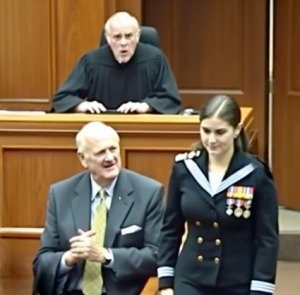
Judge Simmons nodded thoughtfully. “And how do you respond to the claim of abandonment?”
“Your Honor,” I said, “my absence was the result of my military service. As a Navy SEAL, I was deployed overseas in roles that demanded my full commitment. At no point did I intend to abandon the property—or my family. My absence was a matter of duty, not neglect.”
The judge leaned back slightly, his eyes narrowing as he considered my words. “Mr. and Mrs. Carter,” he said, turning to my parents, “do you have evidence that your daughter abandoned her responsibilities?”
My father hesitated before speaking, his voice edged with frustration and regret. “She left without a word. We thought she’d forgotten us—forgotten her family.”
The words stung. “It wasn’t that simple, Dad,” I said quietly, momentarily forgetting the formality of the courtroom. “Serving my country didn’t mean leaving you behind. I was answering a calling. I hoped you’d understand—even if it took time.”
My mother finally spoke, her voice barely audible. “We didn’t understand, Evelyn. We thought you chose them over us.”
“I never chose one over the other,” I replied gently. “I chose to serve—not to abandon.”
Knox brushed against my leg, a small, grounding reminder to stay present.
Judge Simmons cleared his throat, reclaiming the room’s attention. “The law regarding property and abandonment is clear. Commander Carter has demonstrated continued responsibility for the property.” He paused, his expression softening as he looked at my parents. “Your feelings are valid, but legally speaking, Commander Carter did not abandon her home.”
Relief washed over me, though it carried a bittersweet edge. My parents looked defeated, and I wondered how wide the distance between us had grown—and whether it could still be crossed.
“Family matters are complex,” the judge continued. “But this court addresses legal issues, not emotional ones. I encourage you to speak openly with one another outside this room.” He struck his gavel lightly. “Case dismissed.”
As I turned to leave, the weight of years of misunderstanding lingered heavily in the air. My father met my eyes—softer now, perhaps holding an unspoken apology. My mother gave a small nod, acknowledging a truth she had long resisted.
Walking into the sunlight with Knox at my side, I realized this marked the start of a new mission—not one of service or duty, but of healing. The uniform had shown them who I had become. Now it was time to remind them who I still was: their daughter.