At first, people thought it was just smoke.
The kind that drifts up from somewhere far away, easy to ignore when you’re busy with a Saturday afternoon. A smell in the air. A haze that makes you squint, then shrug it off.
But it didn’t fade.
It thickened. Darkened. Started moving faster than it should.
Within minutes, the calm cracked.
Someone yelled. Another person ran. And suddenly, the sky itself looked wrong—heavy, black, pressing down on a neighborhood that wasn’t built to handle panic.
What happened next didn’t unfold slowly.
It rushed.
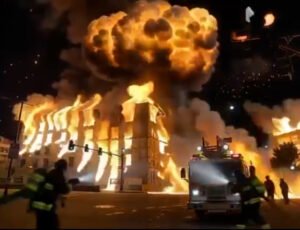
Flames jumped rooftops the way rumors spread. One structure ignited, then another, then three more, until it was impossible to tell where it had started or where it might end.
People grabbed what they could carry.
Some grabbed nothing at all.
The sounds came in layers. Shouting. Sirens. The sharp, terrifying pop of small explosions echoing through narrow streets. Phones came out. Videos started recording. Hands shook.
The fire didn’t care.
It moved through tightly packed homes built from wood, tin, plastic—whatever was available when shelter mattered more than safety. Houses pressed close together like they were leaning on each other for support.
And that closeness became the problem.
By the time emergency crews arrived, the blaze had already taken control of an entire block. Firefighters worked from every angle they could reach, battling heat so intense it forced them back again and again.
Still, they pushed forward.
Water sprayed. Flames roared. Ash fell like dirty snow.
Neighbors who had lived side by side for years stood together in the street, watching everything they owned disappear in real time. Some cried. Some stared silently, eyes fixed on the glow.
There’s a kind of shock that looks like calm.
Witnesses said the fire seemed to change behavior suddenly, flaring brighter, louder. That’s when people noticed something else—small blasts mixed in with the flames. Not big explosions, but enough to make everyone step back.
That detail spread fast.
Whispers turned into worried guesses.
Was there something inside one of the homes?
Hours later, officials would confirm what many feared: the fire appeared to have reached a clandestine fireworks workshop hidden within the neighborhood. A place storing pyrotechnic materials that had no business being there.
That discovery shifted everything.
It explained the rapid spread. The sudden bursts. The way the fire behaved like it had a mind of its own.
Investigators are now treating that site as a likely starting point, though the formal cause is still under review.
By the time the flames were finally contained, the damage was overwhelming.
Some estimates say dozens of homes were affected.
Others say more than a hundred.
The number keeps changing because counting loss like this isn’t simple. When homes are improvised, when families share walls and spaces blur, where does one house end and another begin?
What’s clear is this: hundreds of people were left without a place to sleep.
No bedrooms. No kitchens. No safe corner to retreat to once the adrenaline wore off.
The fire happened in the Pamplona Alta sector of San Juan de Miraflores, a district in Lima where many families already live close to the edge. Where homes are built little by little, with whatever materials are available.
That reality made the fire worse—and the aftermath heavier.
Authorities say the blaze has been confined. No longer spreading. No longer an immediate threat to surrounding areas.
But “contained” doesn’t mean over.
Emergency crews stayed on scene long after the flames died down, navigating debris still warm to the touch. Officials walked through the wreckage, trying to assess what remained and what was gone for good.
Families waited nearby with bags, pets, children clinging to their legs.
Some kept asking the same question: When can we go back?
No one had an answer.
Local officials have begun coordinating aid, but the need is urgent. Shelter. Food. Clothing. Basic supplies. For many, everything burned.
Citizen videos circulating online show just how fast it all happened. In some clips, the fire is small, manageable. In others—taken minutes later—it’s already towering, unstoppable.
That speed is what haunts people.
How quickly normal turned into nothing.
Firefighters explained that the materials used in many of the homes made the blaze almost impossible to slow once it gained momentum. Add in illegal storage of fireworks, and the situation became volatile in every sense of the word.
There’s frustration in the air now.
Questions about safety. About oversight. About how something so dangerous could exist in the middle of a residential area without anyone stepping in sooner.
But there’s also exhaustion.
And grief.
And the quiet disbelief that settles in once the noise fades.
Night fell, and the glow was gone, replaced by darkness broken only by emergency lights. Families huddled together, unsure where they would sleep. Volunteers began to arrive. Strangers offering water. Blankets. A place to sit.
In disasters like this, community shows up fast.
But so does reality.
Rebuilding won’t be quick. Investigations take time. Aid moves slower than fire. And for the people who lost everything, patience feels like an impossible ask.
Officials say assessments are ongoing. Numbers may change. Causes will be confirmed.
But for those who stood there watching their homes burn, the details already feel painfully clear.
They know the sound flames make when they find something explosive.
They know how heat feels when it pushes you backward.
They know what it’s like to leave with nothing but the clothes you’re wearing.
And as the smoke finally clears over Pamplona Alta, one thing lingers heavier than the ash.
The sense that this story isn’t finished.
Not for the families still waiting.
Not for the investigators digging through charred remains.
Not for a neighborhood that went to sleep on a Saturday afternoon thinking it was just another day…
and woke up to something entirely different.