It started like any other workday.
Hard hats. Coffee cooling too fast. The low, familiar hum of machines doing what they’ve done a thousand times before.
No one woke up expecting the ground to move.
From the outside, everything looked solid. Steel locked in place. Concrete set. A structure rising exactly the way it was supposed to. The kind of progress people drive past without thinking twice.
That’s what makes what happened next so hard to shake.
There was no countdown. No shouted warning. Just a sound that didn’t belong—deep, metallic, wrong. The kind of noise your body reacts to before your brain catches up.
Witnesses say it felt like thunder, but closer. Inside the chest. Like the air itself suddenly got heavy.
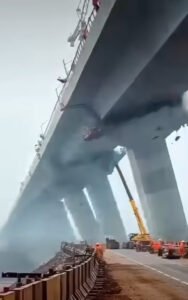
Then things started bending.
Steel didn’t snap cleanly. It twisted. Concrete didn’t crumble politely. It cracked, groaned, and shifted as if it were alive and trying to escape its own weight.
For a split second, no one moved.
That pause—that frozen beat where everyone’s mind is screaming this can’t be happening—might be the scariest part.
Training kicked in before panic could take over.
Someone yelled. Others didn’t wait to ask questions. Tools were dropped. Boots hit the ground running. Every instinct said the same thing: get out now.
And somehow, unbelievably, they did.
Within seconds, the framework gave way. What had been standing moments earlier folded in on itself, collapsing like it had finally decided it couldn’t hold the lie any longer.
Dust filled the air. Noise swallowed everything. The kind of chaos that usually ends with sirens and silence.
But this time, something was different.
When the dust settled, there were no bodies pinned beneath twisted steel. No frantic headcounts turning into screams.
Everyone was out.
Not unscathed—some workers were injured, scraped, shaken—but alive.
That realization hit almost as hard as the collapse itself.
People stood there staring, trying to process how close it came. How narrow the margin really was. How easily this story could’ve ended in a completely different way.
And that’s when the comparisons started.
Because if you’ve lived long enough in this country, you’ve seen this movie before. You remember the images burned into your brain. The bridge that fell. The cars swallowed. The lives lost in a moment that was supposed to be routine.
That memory hangs over every structure like this, whether anyone says it out loud or not.
As investigators moved in, the questions followed quickly. Not the emotional ones—the technical ones. The uncomfortable ones.
Was the load right?
Were the calculations off?
Did something get missed because it always had before?
Early signs point to issues that sound boring until they aren’t. Design choices. Weight distribution. Assumptions made on paper that don’t always behave the same way in the real world.
The kind of details that never trend… until they fail.
Experts say near-misses like this are warnings, not flukes. That structures don’t just collapse out of nowhere. They whisper first. Then creak. Then beg to be noticed.
The scary part?
Most people never hear those whispers.
Drivers will one day pass over this spot without knowing how close it came to becoming a headline everyone would remember for decades. Parents will drive kids to school. Trucks will roll by. Life will keep moving.
And that’s exactly why moments like this matter.
Because luck is a terrible safety plan.
The workers who walked away did everything right in the seconds that mattered. Training saved them. Awareness saved them. Instinct saved them.
But training shouldn’t be the last line of defense.
There’s something deeply unsettling about watching something meant to support thousands of lives decide, without warning, that it can’t.
It makes you think about all the other structures we trust without question. The bridges we cross half-asleep. The overpasses we idle under in traffic. The scaffolding rising quietly in cities everywhere.
How much of it is solid… and how much is just holding on?
No one died this time. And that fact deserves to be said out loud.
But the absence of tragedy doesn’t mean the absence of danger.
If anything, it makes the silence afterward louder.
Because now everyone involved knows what it sounds like when steel gives up. They know how fast “fine” turns into “run.” They know how thin the line really is.
And somewhere between the relief and the questions, there’s a feeling that doesn’t quite settle.
A sense that this wasn’t the end of the story.
Just the moment it almost became one we’d never forget.